Soap and detergent formulation
0% Completed
Measurements
In detergent manufacturing, scaling up production involves converting quantities between grams and kilograms, as well as understanding the relationship between volume and mass for liquid components. For example, a detergent powder recipe might specify amounts in grams, which then need to be scaled up to kilograms or even larger batches for commercial production. Similarly, liquid ingredients like surfactants or fragrances are often measured in liters or milliliters, requiring conversions to grams or kilograms for accurate mixing in the overall formulation.
History of soap and Detergent Manufacturing
Soap and detergent are both cleaning agents that act as surfactants, assisting water to mix with oil and dirt for easier removal, but they differ in their composition and origin: soap is made from natural fats or oils, while detergents are synthetic.
History of Soap and Detergent
Video - 00:00 mins
Difference between Soap and Detergent
Video - 00:00 mins
Different types of detergents
Video - 00:00 mins
Dishwashing products
Video - 00:00 mins
Household cleaning products
Video - 00:00 mins
Personal care products
Video - 00:00 mins
History of soaps and detergent
Quiz
Chemistry of Soaps and Detergents
Soap molecules are sodium or potassium salts of long-chain carboxylic acids (fatty acids).
The "head" of the soap molecule is a negatively charged carboxylate group (-COO-) that is attracted to water (hydrophilic).
The "tail" is a long hydrocarbon chain that is repelled by water but attracted to oil and grease (hydrophobic).
Detergent molecules also have a hydrophilic head and a hydrophobic tail, but the chemical structure of the head and tail can vary.
The hydrophilic head can be ionic (like a sulfate or sulfonate group) or non-ionic (like a long ethylene oxide chain).
The hydrophobic tail can be a long hydrocarbon chain, similar to those in soap, or a more complex structure.
Soaps
Video - 00:00 mins
Fatty acids
Video - 00:00 mins
Glycerol
Video - 00:00 mins
Triglycerides
Video - 00:00 mins
Hydrolysis of triglycerides
Video - 00:00 mins
Saponification
Video - 00:00 mins
Formation of soap via saponification
Video - 00:00 mins
Structure of Soap
Video - 00:00 mins
Synthetic detergents
Video - 00:00 mins
Cleansing action of soap and detergent
Video - 00:00 mins
Hydrophilicity and hydrophobicity of soap and detergents
Video - 00:00 mins
Effect of water hardness in soap and detergents
Video - 00:00 mins
Syndet (Synthetic detergents)
Video - 00:00 mins
Advantages and disadvantages of synthetic detergents
Video - 00:00 mins
Surfactant
Video - 00:00 mins
Anionic Surfactant
Video - 00:00 mins
Cationic Surfactant
Video - 00:00 mins
Nonionic Surfactants
Video - 00:00 mins
Amphoteric surfactant
Video - 00:00 mins
Builders and chelants
Video - 00:00 mins
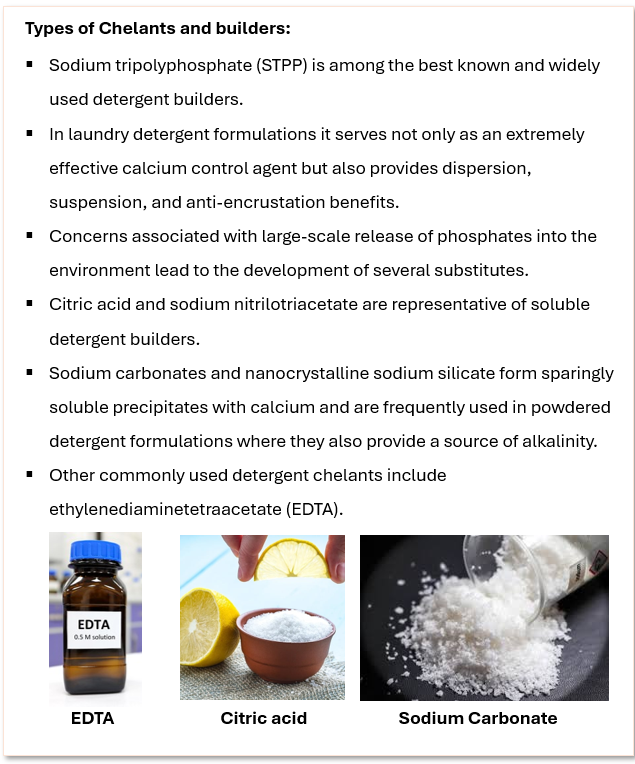
Types of Chelants and builders
Video - 00:00 mins
Bleaching agents
Video - 00:00 mins
Solvents
Video - 00:00 mins
Enzymes
Video - 00:00 mins
Brighteners/fabric whitening actives
Video - 00:00 mins
Foam boosters
Video - 00:00 mins
Antifoaming agent
Video - 00:00 mins
Thickeners
Video - 00:00 mins
Perfume
Video - 00:00 mins
Chemistry of soaps and detergent
Quiz
Acid and Base
Acid and bases forms an important aspect of detergent chemistry more especially the quality aspect of it. Acid and bases are important because cleaning detergents are found in either acidic or basic form which determine the particular cleaning application.
Soap and detergent manufacturing processes
Soap and detergent forms an important aspect of daily life due to the need for a good hygiene. Soap and detergent are produced using batch, continuous or spray drying and agglomeration.
Quality Control in detergents and soap production
In scientific background: quality refers to excellence or a state of being free from defects, deficiencies and significant variations. Quality scientists ensure that a product is suitable for its intended purpose. They increase the reliability, integrity and trustworthiness of the products we use every day. Quality means that the products meet and exceed all requirements, standards and specifications. For example, certain industry products may need to meet specific standards and specifications for legal or medical reasons. Many companies also develop their own set of quality requirements that each product or service must meet before releasing it to the public.
Managing costs
Video - 00:00 mins
Build a reputation
Video - 00:00 mins
Leading the Industry
Video - 00:00 mins
Customer loyalty
Video - 00:00 mins
Quality Control parameters in liquid detergent
Video - 00:00 mins
Raw Material Inspection
Video - 00:00 mins
Process Control
Video - 00:00 mins
Product testing
Video - 00:00 mins
Spectrophotometer
Reading
Colour
Reading
Viscosity
Reading
Relationship between viscosity and cleaning performance
Reading
Factors influencing viscosity
Reading
Temperature, pH and fragrance
Reading
Active matter performance
Reading
Packaging Inspection
Video - 00:00 mins
Cost and pricing stratergy
Reading
Techniques and methods used in quality control (QC)
Video - 00:00 mins
Sampling
Video - 00:00 mins
Analysis
Video - 00:00 mins
Reporting
Video - 00:00 mins
Quality control in soaps and detergents
Quiz
Setting up a batch production process
Batch production is a manufacturing method wherein a group of identical products are produced in one batch instead of one at a time. These sets of products are manufactured within a specific timeframe and according to a predetermined interval. Products in a batch then go through different steps of the manufacturing process together, and after, they will be evaluated as a group accordingly.
Considerations during formulations
Reading
Customer needs
Reading
Quality of raw chemicals
Reading
Research nd development (R&D)
Reading
Impact of product quality and cost
Reading
Batch process
Video - 00:00 mins
Advantages and Disadvantages of Batch process
Video - 00:00 mins
Setting up a batch process
Video - 00:00 mins
Setting up batch process continuation
Video - 00:00 mins
Batch process
Quiz
Good manufacturing practices (GMP)
Good manufacturing practices (GMP) is a rigorous set of regulations that must be followed by companies who are producing products for commercial use. GMP is an essential tool in any industry, from food production to pharmaceuticals, as it mandates to ensure compliance in safety and health of consumers. GMP also ensure the guarantee in the quality of the products produced by ensuring they meet all safety and regulatory requirements. Compliance with GMP regulations ensures that products are safe to use and provides confidence to consumers that the product they are using is free from potential hazards.
Overview of GMP
Video - 00:00 mins
Quality Assurance
Video - 00:00 mins
Examples of QA
Video - 00:00 mins
Good manufacturing practices
Video - 00:00 mins
Example of GMP
Video - 00:00 mins
Good documentation practices (GDP)
Video - 00:00 mins
Examples of GDPs
Video - 00:00 mins
Quality Control Systems
Video - 00:00 mins
Training
Video - 00:00 mins
Good manufacturing practices
Quiz
Good Laboratory Practices
Good Laboratory Practice (GLP) is a quality system that outlines the organizational process and conditions under which non-clinical laboratory studies are planned, performed, monitored, recorded, reported, and archived. GLP ensures the quality and integrity of safety test data submitted to the government for the issuance of research permits.
Good Laboratory Practice Guidelines
Video - 00:00 mins
Facility & Equipment
Video - 00:00 mins
Characterization
Video - 00:00 mins
Study plan or protocol
Video - 00:00 mins
Standard Operating Procedure (SOP)
Video - 00:00 mins
Final Report
Video - 00:00 mins
Storage of Records
Video - 00:00 mins
Retention of Records
Video - 00:00 mins
Good laboratory practices
Quiz
Basic formulation
Formulation is a process of combining raw materials which are compatible with each other to make product or an object that has value.
Chemical Handling
Safe chemical handling involves understanding chemical hazards, using appropriate personal protective equipment (PPE), following established procedures, and implementing effective storage and disposal practices.
Identifying hazards
Reading
Modes of exposure
Reading
Labelling requirements
Reading
Material safety data sheet (MSDS)
Reading
Minimizing hazards
Reading
Engineering controls
Reading
Techniques for minimizing hazards
Reading
Chemical storage
Reading
Types of explosive chemicals
Reading
Personal protective equipment
Reading
Protective gloves
Reading
Face protective equipment
Reading
Face protective equipment
Reading
Respiratory protective equipment
Reading
Safety shoes
Reading
General safety in the laboratory
Reading
Preparing for emergencies
Reading
Types of fire extinguishers
Reading
Eye wash station
Reading
Safety shower
Reading
Small and large spills
Reading
Spill management
Reading
Chemical handling
Quiz
Practical videos
Detergent formulation involves combining various chemical ingredients, primarily surfactants, builders, and other additives, to create a product that effectively cleans different types of surfaces. The specific formulation depends on the type of detergent (e.g., laundry powder, liquid, or dish soap) and the desired cleaning performance.
Finish Course Early?
You have not completed all required lessons and assessments.
Your Progress
0%
